And it is rarely the technology itself.
Executive summary
Most financial services firms have deployed AI, but few can show it is paying off. Research in 2026 from Gartner, Deloitte, McKinsey, BCG, Grant Thornton, and others, shows that five barriers keep recurring, and the AI model itself is rarely one of them:
- Thin in-house expertise and bandwidth. The people running the business are also expected to run the AI program.
- Governance that exists on paper but has never been tested. Only 18% of banks are fully confident in their AI controls (Grant Thornton).
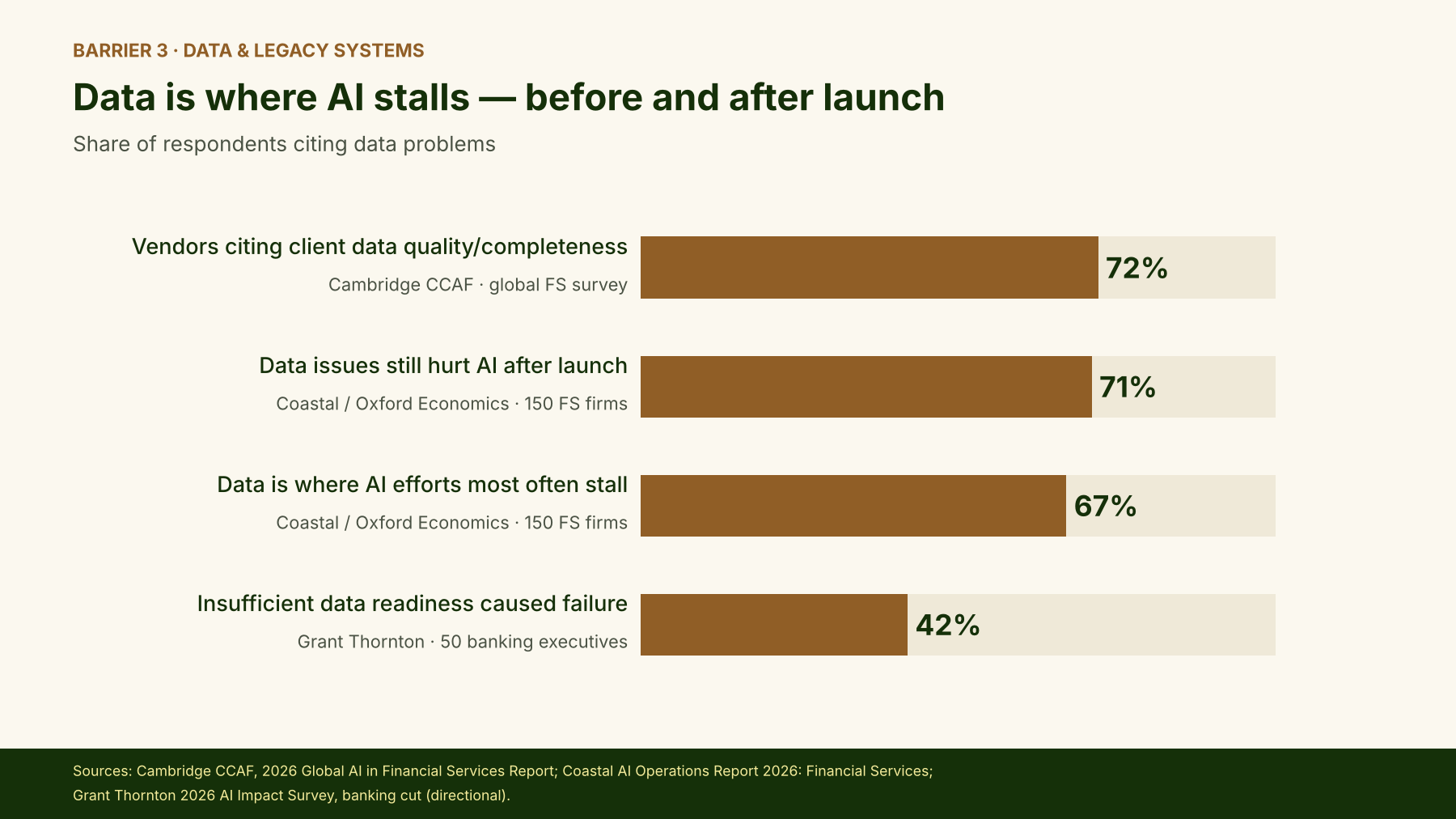
- Data that is not ready, in legacy systems. 67% of financial services firms say data is where AI efforts most often stall (Coastal).
- AI bolted onto old workflows. Only 2% of banks say AI is fully integrated into their operations (Grant Thornton).
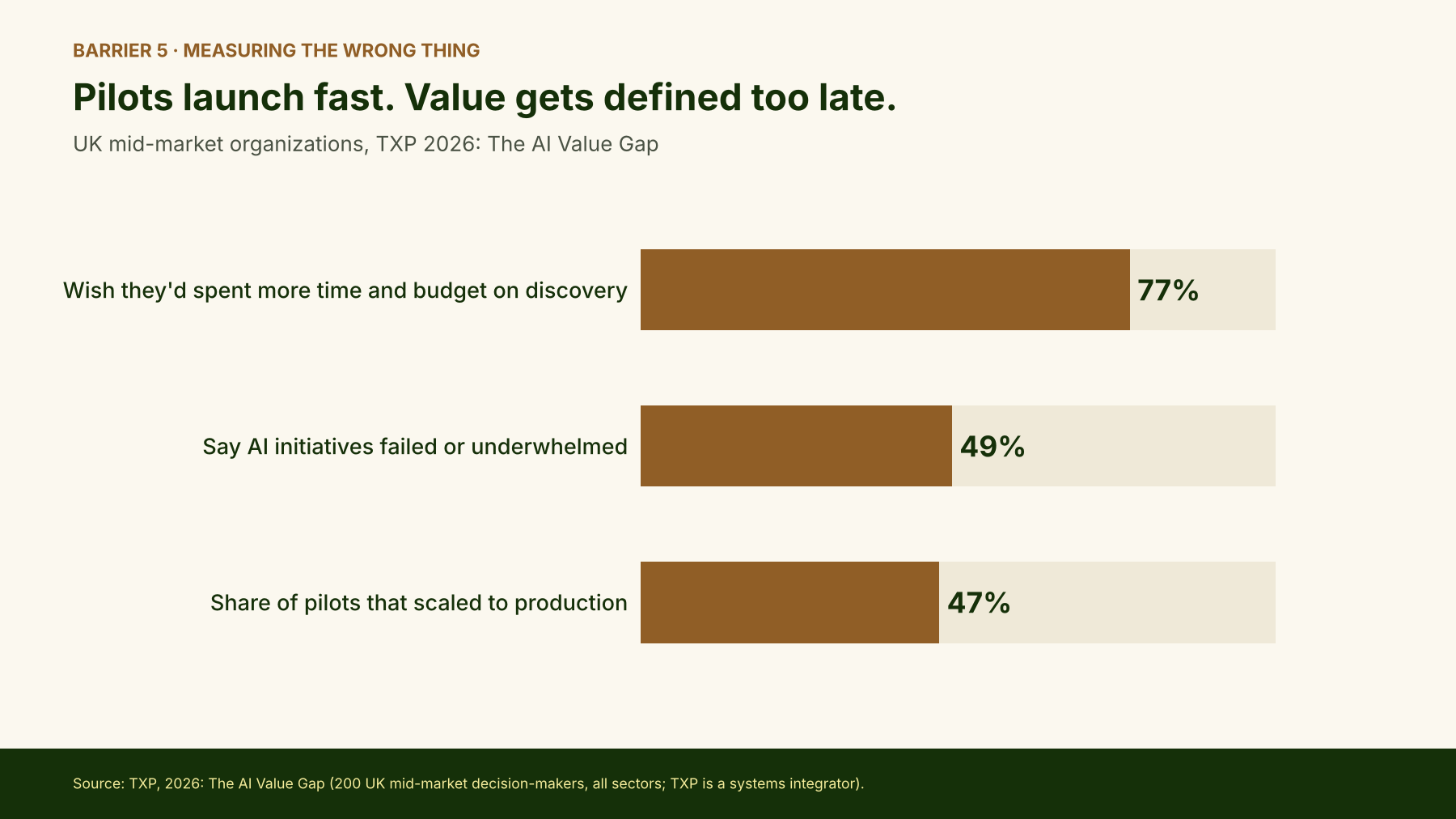
- Measuring deployment instead of value. 77% of mid-market firms wish they had spent more on discovery first (TXP).
The barriers were the same for the firms represented in the surveys, but firm size changes which barrier hurts most. Large institutions struggle with complexity, but mid-sized firms struggle with capacity.
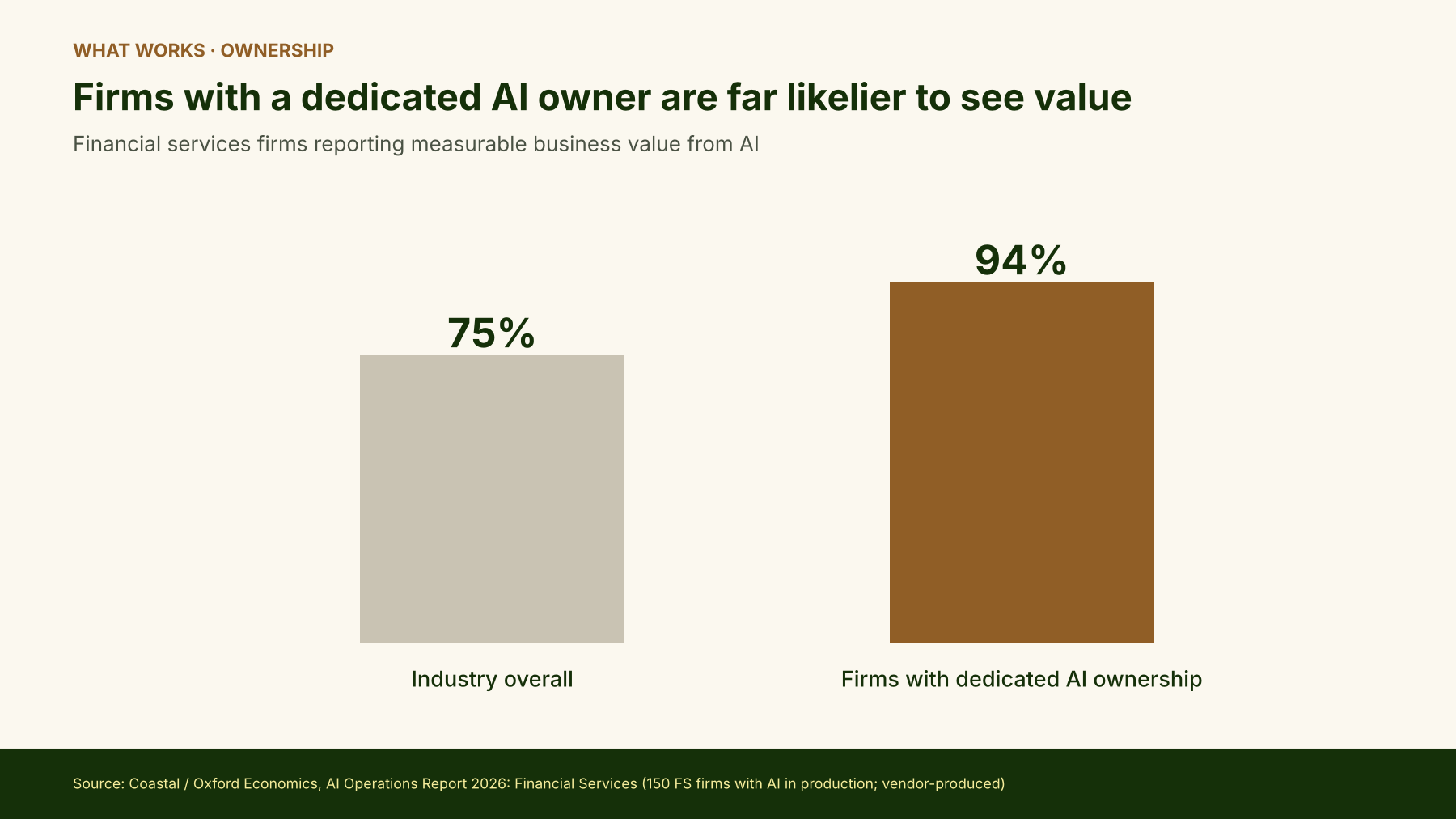
The firms that get value share a pattern: a named owner, governance that is tested, data fixed in stages, redesigned workflows, and value defined before the pilot starts. Firms with dedicated AI ownership report measurable value at 94%, compared to 75% overall (Coastal).
AI adoption in finance services is no longer the problem. Getting value from it is.
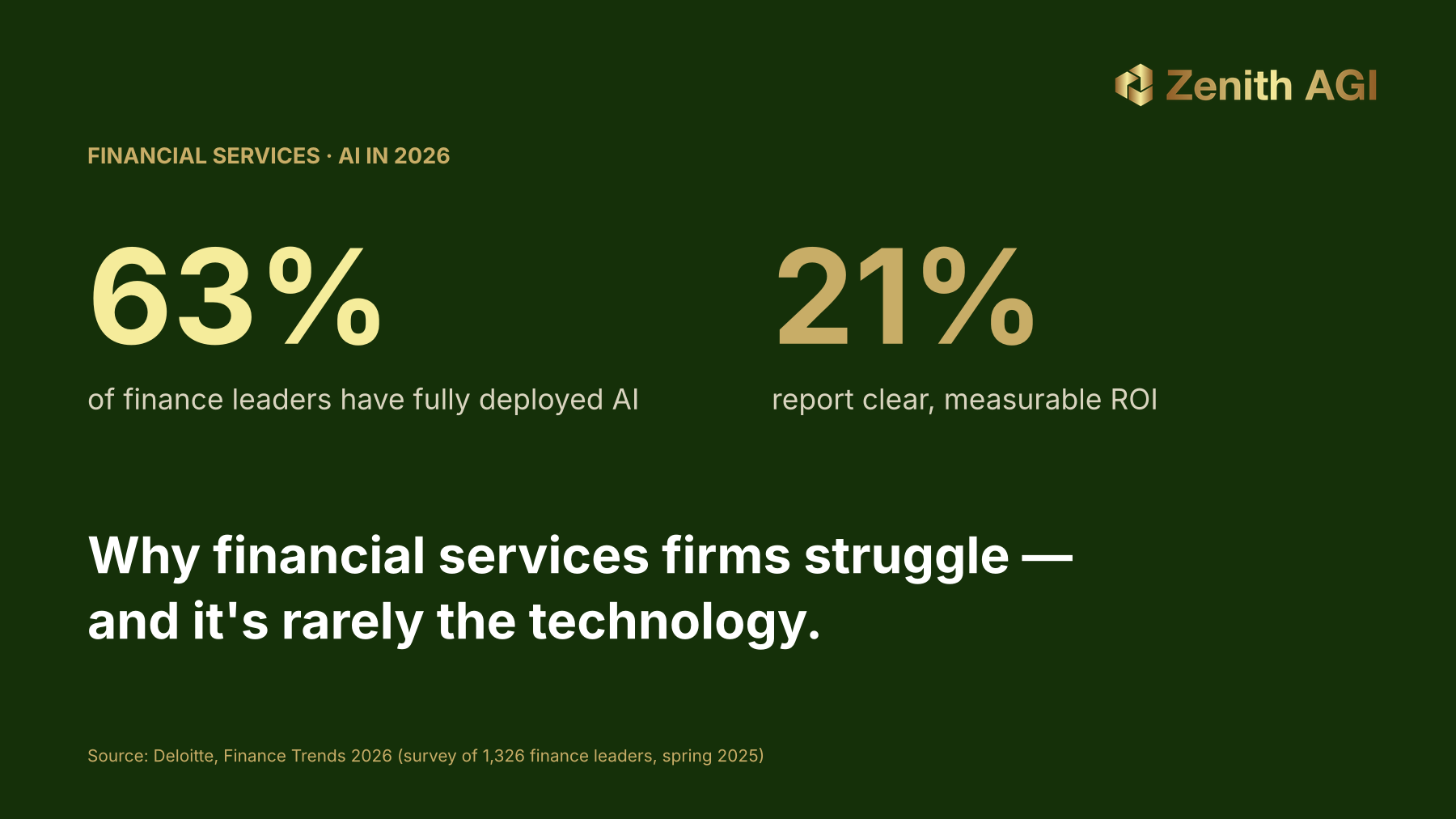
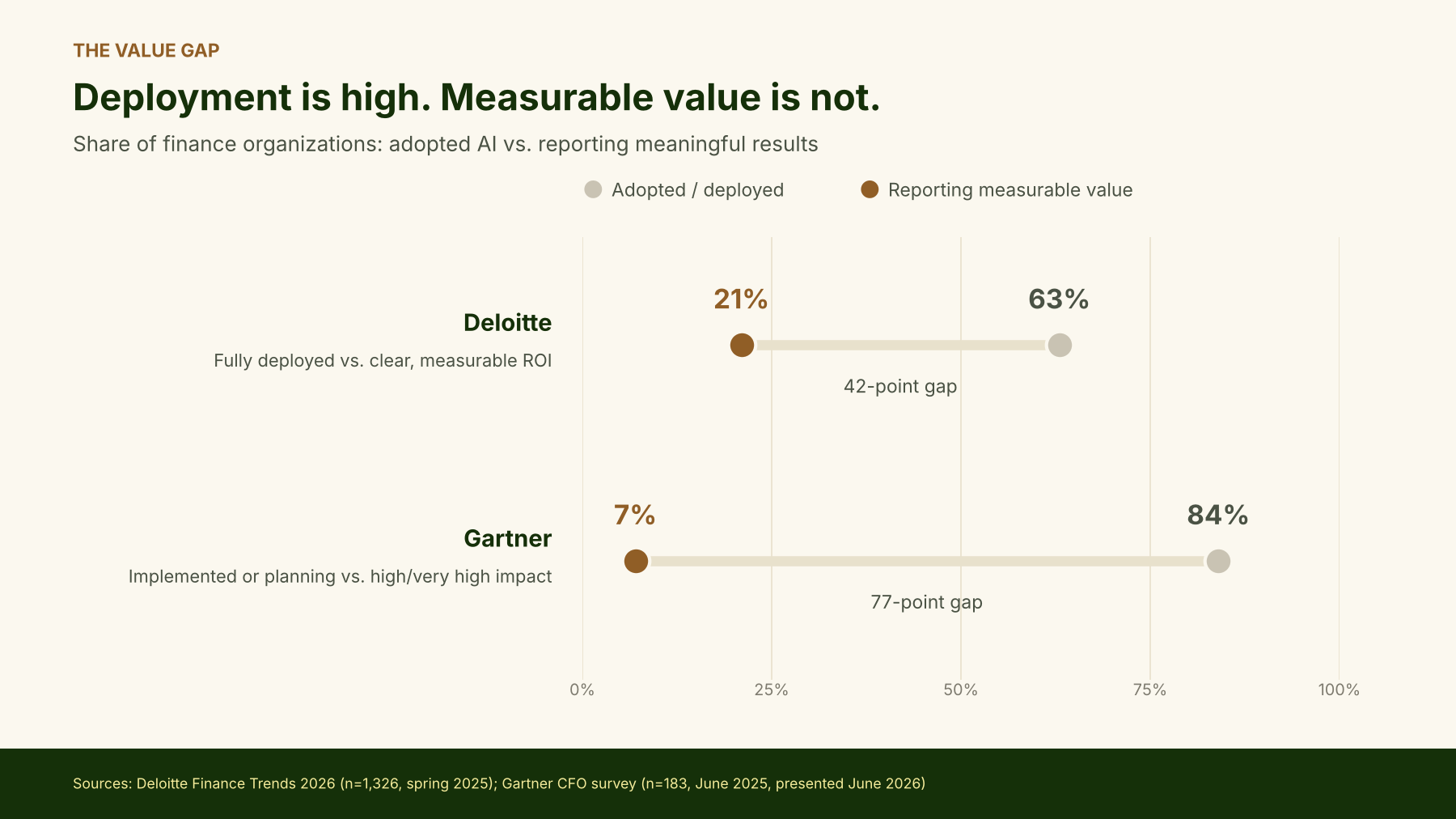
Deloitte surveyed 1,326 finance leaders for its Finance Trends 2026 report. It found that 63% have fully deployed AI, but only 21% report clear, measurable ROI. Gartner's numbers point the same way: 84% of finance organizations have implemented AI or plan to, yet only 7% report high or very high impact.
I went through this year's research from Gartner, Deloitte, McKinsey, BCG, Grant Thornton, Accenture, and Cambridge Judge Business School, plus several industry surveys of banks and credit unions. The same five barriers listed above come up repeatedly, and the AI models are rarely one of them.
Same gap, different reasons
Financial services firms are dealing with the same five barriers, however, the size of the firm changes which barrier has more impact.
Large institutions struggle with complexity. Grant Thornton finds that large firms struggle to change processes across hundreds of interdependent systems. McKinsey's 2026 banking review found that in the U.S., bigger banks are not necessarily more efficient or more profitable for shareholders. Scale can work against them. BCG makes the same point from the other side by pointing out that AI-native competitors carry no inherited workflows or legacy cost base. Therefore, bolting AI onto an existing operation closes only part of the gap.
Mid-sized firms struggle with capacity. Grant Thornton finds that regional institutions often lack the AI and data expertise needed to redesign workflows and put controls into practice. In a survey of U.S. banks and credit unions, 62% named lack of internal expertise or resources as their top barrier. Across financial services firms, 68% said team bandwidth limits how much AI they can run.
The fix differs too. A large firm must simplify and coordinate what it already has. A mid-sized firm must gain capacity it does not have. Specifically, a named owner, focused use cases, and outside AI specialists.
1. Thin in-house expertise and bandwidth
This barrier hits mid-sized firms hardest.
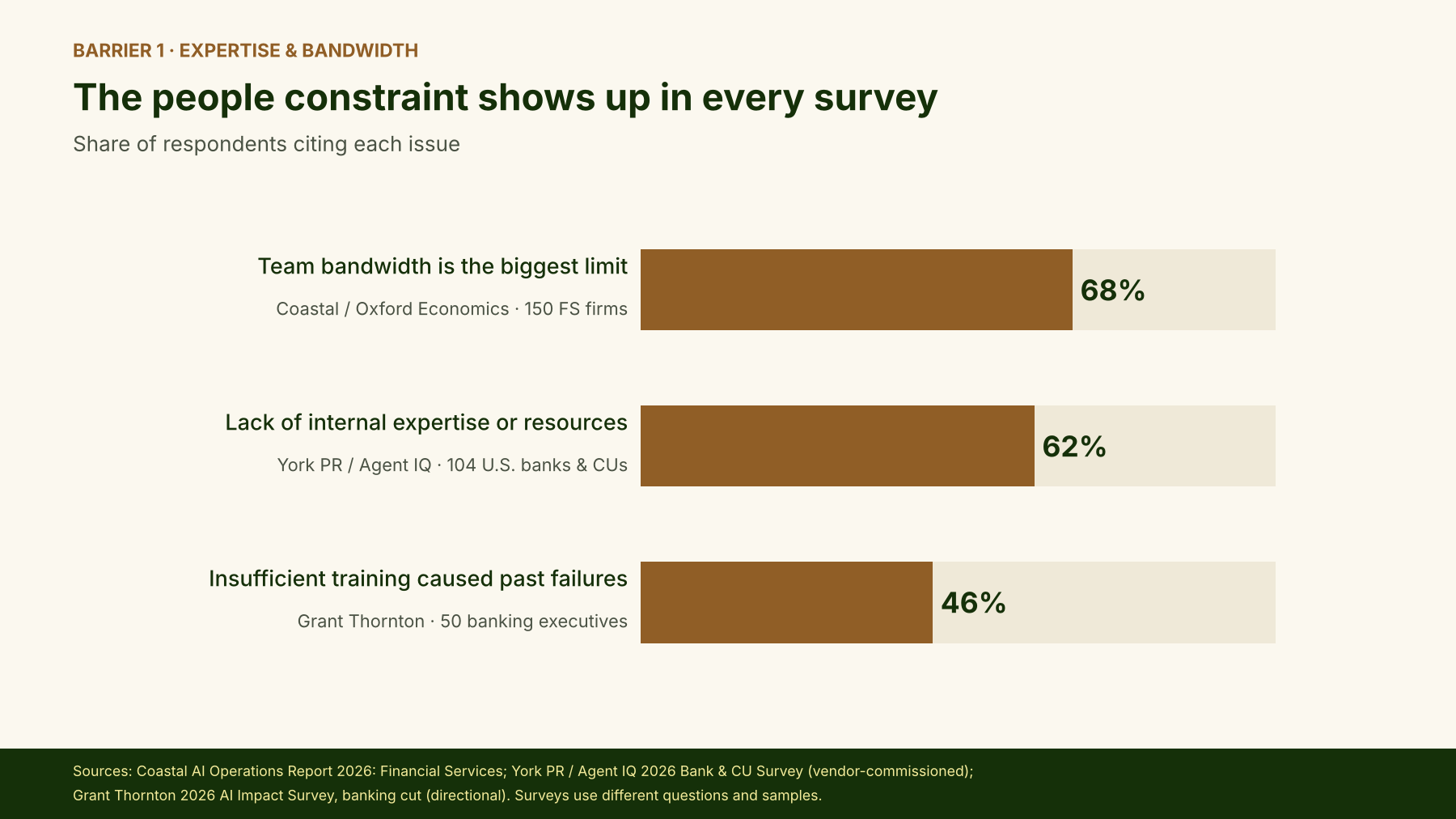
- In a 2026 survey of 104 U.S. banks and credit unions, 62% named lack of internal expertise or resources as their top barrier.
- In a survey of 150 financial services firms, 68% said team bandwidth is the biggest limit on how much AI they can run/deploy.
- Grant Thornton found that 46% of banking executives blame insufficient training for past AI projects that underperformed or failed.
- Gartner now calls “low AI literacy” the most significant barrier finance leaders face.
Mid-sized firms do not have a bench of data scientists, risk modelers, and change managers. The same few people who run the business are also expected to run the AI program.
2. Governance that exists on paper but has never been tested
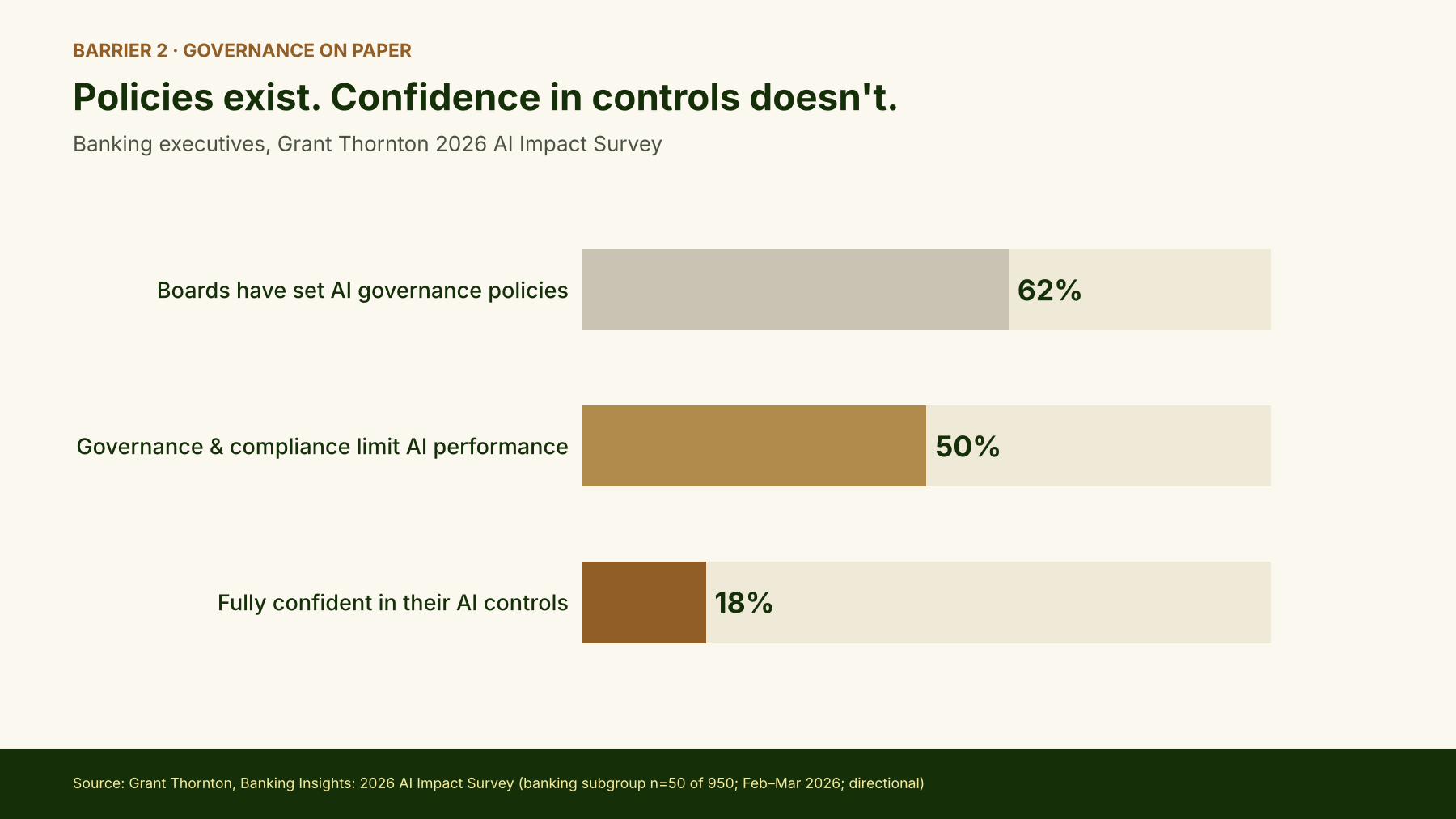
- In Grant Thornton's survey, 62% of banks say their boards have set AI governance policies.
- Half say governance and compliance are already limiting AI performance.
- Only 18% are fully confident in their AI controls.
- McKinsey reports that nearly two-thirds of organizations cite security and risk concerns as the top barrier to scaling agentic AI.
When nobody trusts the controls, AI stays out of the high-value regulated workflows where the returns can be found.
3. Data that is not ready, and the legacy systems it sits in
- 67% of financial services firms say data is where AI efforts most often stall.
- 71% say data issues keep hurting AI performance after launch.
- Cambridge's 2026 Global AI in Financial Services report finds that data quality, talent and legacy architecture are still the core constraints. They were the same top barriers in its 2020 report.
4. AI bolted onto old workflows
Grant Thornton found that banks using AI mostly report efficiency gains (62%). Far fewer report cost reduction (36%) or revenue growth (32%), and only 2% say AI is fully integrated into their operations. McKinsey describes the same pattern as fragmented deployments, and point solutions that are bolted onto existing processes.
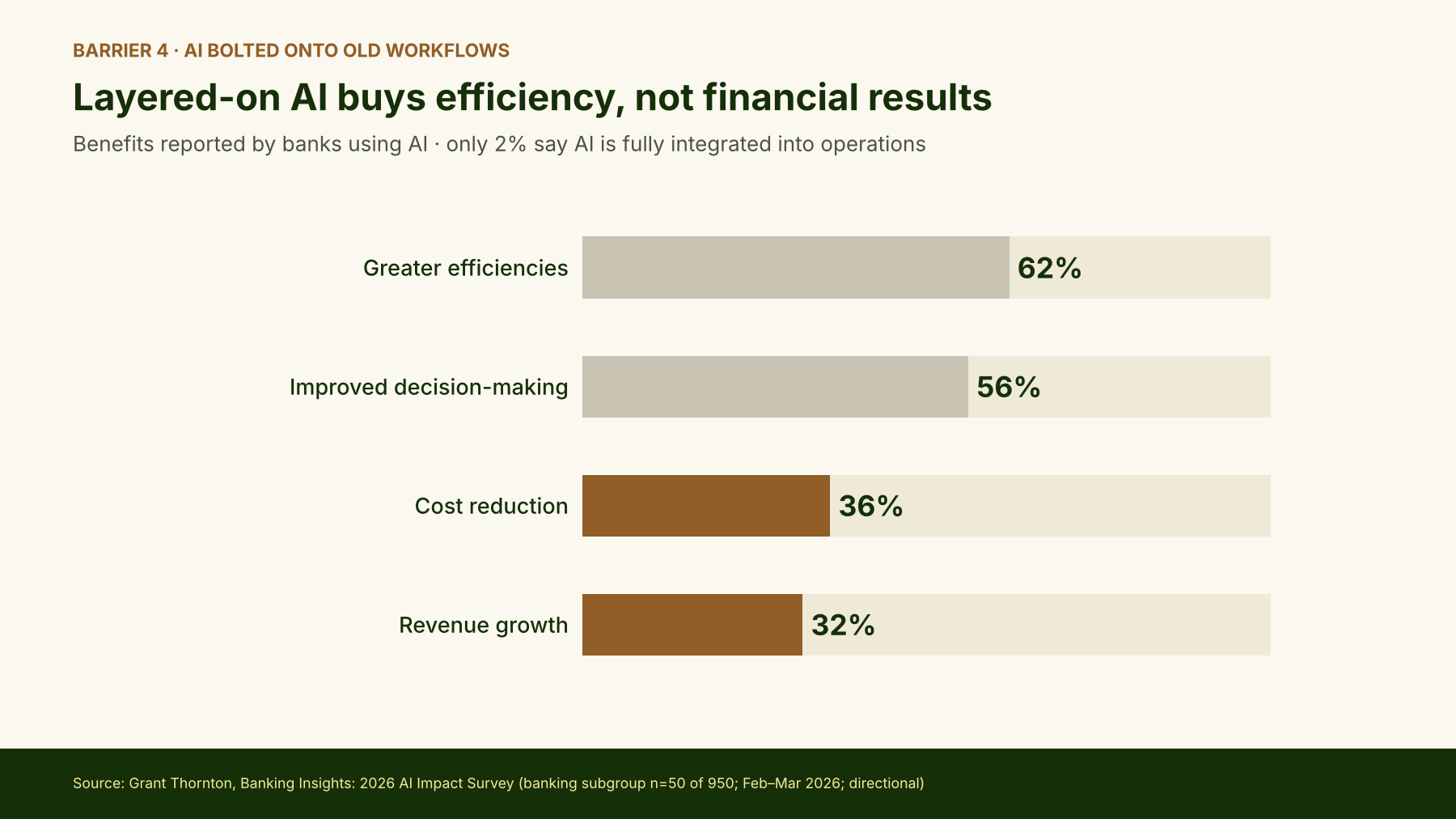
Putting AI on top of an unchanged process only gives you a slightly faster version of that process.
5. Measuring deployment instead of value, and skipping discovery
In TXP's survey of 200 UK mid-market organizations:
- 77% wish they had spent more time and budget on discovery before launching.
- 49% say their AI initiatives failed or underwhelmed.
- Fewer than half of pilots (47%) made it to production.
Gartner's advice to CFOs is to judge AI by the value it delivers, not by how many Ai tools have been deployed.
What needs to change?
- Give AI a named owner. Financial services firms with dedicated AI ownership report measurable value at 94%, against 75% across the industry. Mid-market firms rarely need a large AI department. They need one accountable person, with partners filling the specialist roles.
- Build AI literacy for each role. Gartner recommends literacy programs tailored for specific roles, not generic training.
- Build governance in, from day one, and test it. Grant Thornton's first recommendation is clear decision rights, a defined risk tolerance for each use case, and model validation and auditability written into the workflow itself.
- Fix data in steps, starting with low-risk use cases. You do not need a full rebuild first. AI can help with the data inventory and lineage mapping.
- Redesign the workflow, not just the tool. BCG's 2026 research says the firms that win redesign their operating model rather than make incremental cuts, and that architecture and talent drive the advantage more than tools do.
- Define value before the pilot starts. Agree what success looks like, how it will be measured, and who owns the result.
The takeaway: the firms getting value from AI are not the ones with the best models. They are the ones that have defined AI’s value, fixed its ownership, governance, data, and workflows.
Where is your firm stuck: people, controls, data, or process?
A note on the data: several of these surveys are small or vendor-commissioned (Grant Thornton's banking sample is 50, and the bank and credit union survey is 104). Deloitte's survey was fielded in spring 2025 and Gartner's 84%/7% figure comes from June 2025. Treat them as signals of direction, not precise benchmarks.
Sources
- Deloitte - Finance Trends 2026
- Gartner - CFOs Need Structured Finance AI Roadmaps (June 2026)
- Gartner - CFOs Must Take a More Disciplined Approach (Sept 2026)
- Grant Thornton - Banking Insights: 2026 AI Impact Survey
- McKinsey - State of AI Trust in 2026
- McKinsey - Banking and AI explainer
- BCG - Future of Finance 2026
- BCG - Which Companies Will Capture Value From AI in 2026
- Cambridge Judge Business School - 2026 Global AI in Financial Services Report
- Coastal / Oxford Economics - AI Operations Report 2026: Financial Services
- York PR / Agent IQ - 2026 Bank & Credit Union Survey
- TXP - 2026: The AI Value Gap